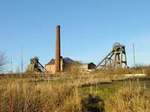


Pleasley Colliery
Pleasley Colliery was sunk in the 1870s and produced coal until 1983. Prior to nationalisation in 1947 it was owned by the Stanton Ironworks Company which had leased the mineral rights in 1872 from the lord of the Manor of Pleasley at that time, William Nightingale (the father of Florence Nightingale).
By some miracle it escaped complete demolition after closure and it still retains its headstocks, engine-houses and steam winders, one of which was installed in 1904 by Lilleshall Co. Ltd. and the other in 1922 by Markham & Co. Ltd.
Pleasley Colliery is now a scheduled Ancient Monument and is in the process of being developed into a mining heritage site. The engine-house roofs and the chimney have been renovated and the winders are in the process of being restored by members of the Friends of Pleasley Pit preservation group and other volunteers.
Pleasley Colliery web site
I worked at Pleasley Colliery back in the 1960s, first as an apprentice, then as an underground electrician. As an apprentice on the pit top I spent a fair amount of time in the engine-houses, particularly on the back shifts and grew to love the old steam engines, especially the big Markham engine which moved so smoothly and effortlessly.
Whilst visiting my parents in January 2005, my Dad told me about the restoration work that was going on so I decided to have a walk along and see what was happening.
The last time I was there in the mid 1980s, the downcast shaft had been capped and the old upcast shaft was supplying air for a link with Shirebrook colliery. Things were in a very poor state however. The engines were still in-situ but the roof was missing from one side and the vandals were busy on the other. The rest of the surface buildings had already gone to the knackers yard. Very depressing. Thanks aunty Maggie !!
This time I was amazed at the transformation. I took as many photos as I could and when I got back home and discovered there was no web site I decided to knock one up. So here we go. (JST Jan 2005)
After many subsequent visits during the year I have discoverd much more information especially about the early development of the pit. I became a member of Friends of Pleasley Pit in the summer which gave me access to historical documentation. I’m now trying to assemble this to give a coherent picture of the pit’s development over the years. (JST Dec 2005)
I’ve had access to lots more technical info and photos over the last year which has provided a clearer picture of the early years and corrected several misunderstandings. The site is being updated to reflect this. Further investigation is planned for the next 12 months. (JST Dec 2006)
Membership of the North of England Institute of Mining and Mechanical Engineers has given me access to their extensive library and has opened up a new, highly productive seam of information. This is now being mined intensively and is yielding some very interesting data. (JST April 2007)
During the last year, visits have been made to several libraries and county records offices where documentation has been identified which can shed considerable light on the early years and which has the potential of resolving a number of long standing puzzles. References to articles and papers by one of the early colliery Agents, found in journals and mining books from the end of the 19th century, are now offering another avenue of investigation whilst inspection of abandonment plans in the Mines Records offices in Mansfield has shown that a detailed examination of these will be most rewarding. (JST July 2008)
Acknowledgments and thanks
It would have been impossible to do any of the background research without the tremendous amount of work that other people have done in collecting, organizing and publishing the information now available on the Web.
Thanks must go to A Bridgewater’s old site for starting me off on the trail, and to the fantastic Durham Mining Museum site which gave me vast amounts of information and a target to aim for.
Special thanks go to Peter Southworth for the work he put into preparing and publishing his book: “Pleasley Pit and its steam winding engines” (ISBN 0-9511856-3-2) and for the fruitful discussions whenever we’ve met.
I’d also like to thank Bob Metcalfe, chairman of the Friends of Pleasley Pit, for providing access to documentation and photos and for the incredible personal effort he and his wife have put into the preservation and restoration of the Pleasley Colliery winders and buildings.
Finally a big thank-you must go to Bolsover District Council for the emergency Grade 2 listing of the buildings in 1986, to the East Midlands Development Agency for their ongoing support for the preservation work and the development of the surroundings as well as to all the various action groups whose determined efforts to preserve the colliery and re-invigorate the area are now starting to bear fruit.
Having said all that, nothing would have been achieved without the unbelievable amount of work put in by the volunteers, the Thursday team especially. They have had to do the dirty, unglamorous yet essential work, but to the visitor their efforts remain unseen. Thank you gentlemen.
Mea Culpa
There are quite a few images on this site whose ownership I have been unable to trace. If you feel that your copyright has been infringed or that you have not been acknowledged then I apologise. Please get in touch with me so that I can remedy the situation.
Errors & Corrections
I’ve tried to be as rigorous as possible in teasing out fact from fiction, but in many cases I’ve not had access to primary sources and in others the information has come from examination of maps, photos etc. If you spot any mistakes please get in touch and I’ll make the appropriate corrections.
Copyright © 2023 J.S. Thatcher
Page updated on:
04 Aug, 2023
at
03:29:43 PM
In case of problems contact:
